
Finding Erie County Resident Records
Erie County keeps useful resident evidence in separate systems. An address begins with Assessment, which provides a public parcel route and recent transfer list. A deed, estate, or marriage question belongs with the Clerk of Records divisions. A name connected to a public court matter belongs in the statewide UJS docket search. For an older household, the Heritage Room at Blasco Memorial Library is often more useful than a modern database because it holds city directories, newspapers, census microfilm, and obituary indexes.
No one source proves that every person at an address lives there now. A transfer lists parties to an event, not every household member. A directory reflects its publication date. Begin with the record that matches the question, then compare it with another source that has a different purpose.
- Use the County property search when a street address or parcel number is known.
- Check the public transfer list for a dated property event, then confirm important details with the Recorder.
- For a known public case, use UJS with the available case or participant details.
- For a past household, compare the relevant directory year with newspapers, census material, or maps.
- Ask the proper custodian about an inspection, copy, or formal request when the public portal does not display the needed record.
Note: A blank search is not proof that a person has no connection to Erie County or that every relevant record is public.
Erie County Resident Records Offices
The Erie County Clerk of Records brings several courthouse functions together, but their records have different rules. The Recorder of Deeds manages land instruments. The Register of Wills handles estate and probate material. Assessment handles property and tax records, while Voter Registration maintains the county registration list. Starting with the correct office saves time and helps keep a resident-record search within the lawful access route.
The Recorder counter, the Assessment office, the elections office, and the County’s formal request channel are separate access routes. A record’s office, year, and legal status decide which route applies.
Erie County Parcel Search Basics
The County Property and Tax Search is the most practical Erie County residents directory starting point for a known address. Its address mode accepts a house number, street direction, and street name. The county instructs visitors to enter only the street name, without Street, St., Road, or Rd. A separate parcel mode requires exactly 14 digits without spaces. The public route can locate a parcel and point toward a map or transfer history, but it does not make every ownership detail freely visible.
| County control | How it works |
|---|---|
| House Number | Optional address component. |
| Street Direction | Optional selector, used with the street name. |
| Street Name | Enter the name only, without a street-type suffix. |
| Parcel Number | Separate route requiring 14 numeric characters. |
| Recent Transfers | Uses oldest date, newest date, and municipality filters. |
The County says owner information now sits in an Owner tab that needs a registered, logged-in account and a $100 unlock payment. A situs address is the parcel’s physical location. It is not a free substitute for an owner mailing address or a household list.
The County Property and Tax Search displays the local address components. 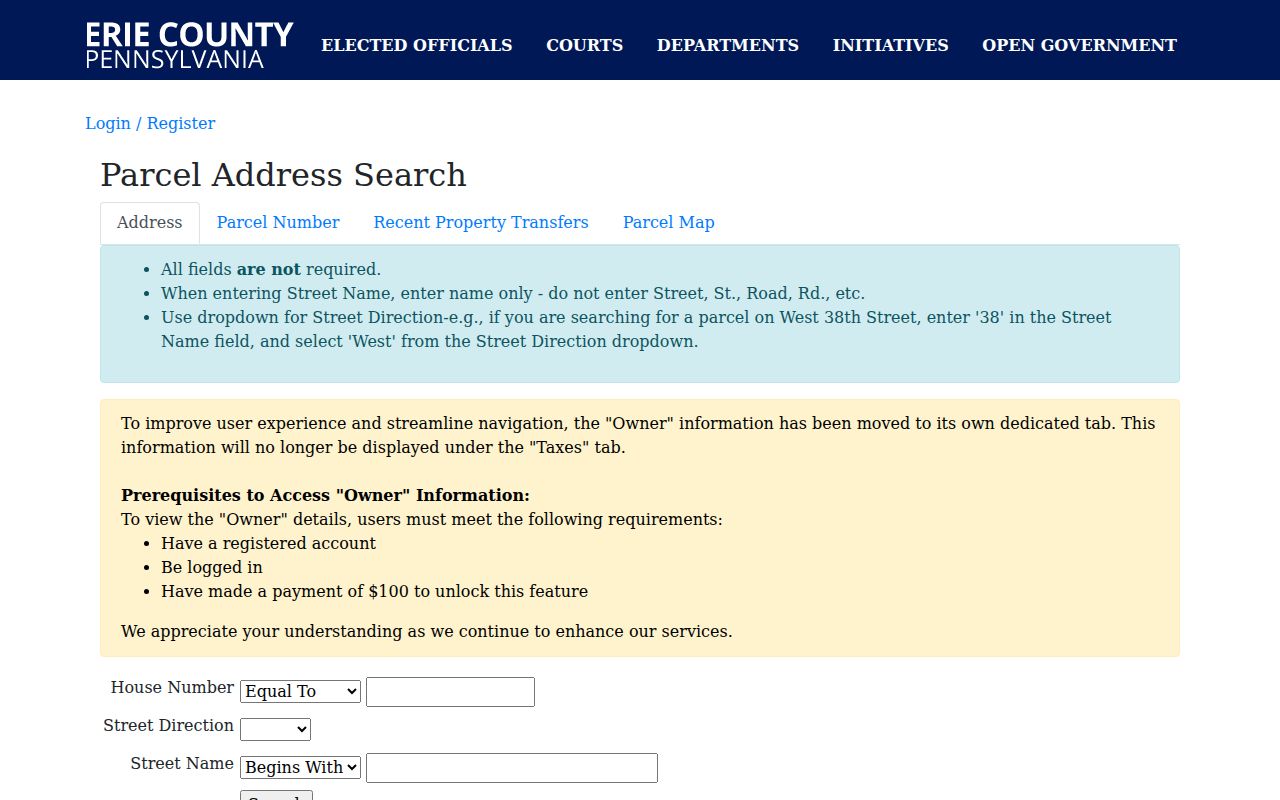 The fields show why an Erie County address should be entered in parts rather than as a full mailing line.
Erie County Transfer and Deed Trails
A public transfer result supplies a lead, not the final answer. Erie County’s recent transfer table shows municipality, address or land details, seller and buyer, an instrument label, price when reported, and a date. A blank price does not establish that no consideration changed hands. The table also does not replace the recorded deed or show all people connected to the property.
The Recorder records and indexes deeds, mortgages, satisfactions, powers of attorney, leases, UCC filings, and related instruments. Its county-linked INFOCON service is a fee-based subscriber route with distinct legacy labels for deed books before 1976 and grantor/grantee history from 1976 through 1995. The Recorder counter remains the useful fallback when the remote route does not supply a particular book, year, or image.
- Parcel
- A numbered land record used to locate a property in assessment and mapping systems.
- Grantor
- The party conveying an interest in a recorded instrument.
- Grantee
- The party receiving that interest in the instrument.
- Legal description
- The lot, block, subdivision, or other land description that carries a trail across changing street forms.
Erie County Voter Status Limits
Pennsylvania’s official voter-status tool is for an individual checking their own registration. It asks for identifying information and returns a status result when there is a match. It is not an Erie County residents directory for browsing a street, a ZIP Code, or nearby homes. If the tool does not find a registration, the State directs the voter to correct the entry or contact the county office.
Election Code section 1404 has a separate controlled public-information-list process. It requires requester identification and a written statement limiting use to election, political, or law-enforcement purposes. Voting history is not a ballot-choice record, and protected addresses remain protected. Those boundaries should be respected rather than bypassed through other data.
The official Pennsylvania voter-status form is designed for self-service confirmation. 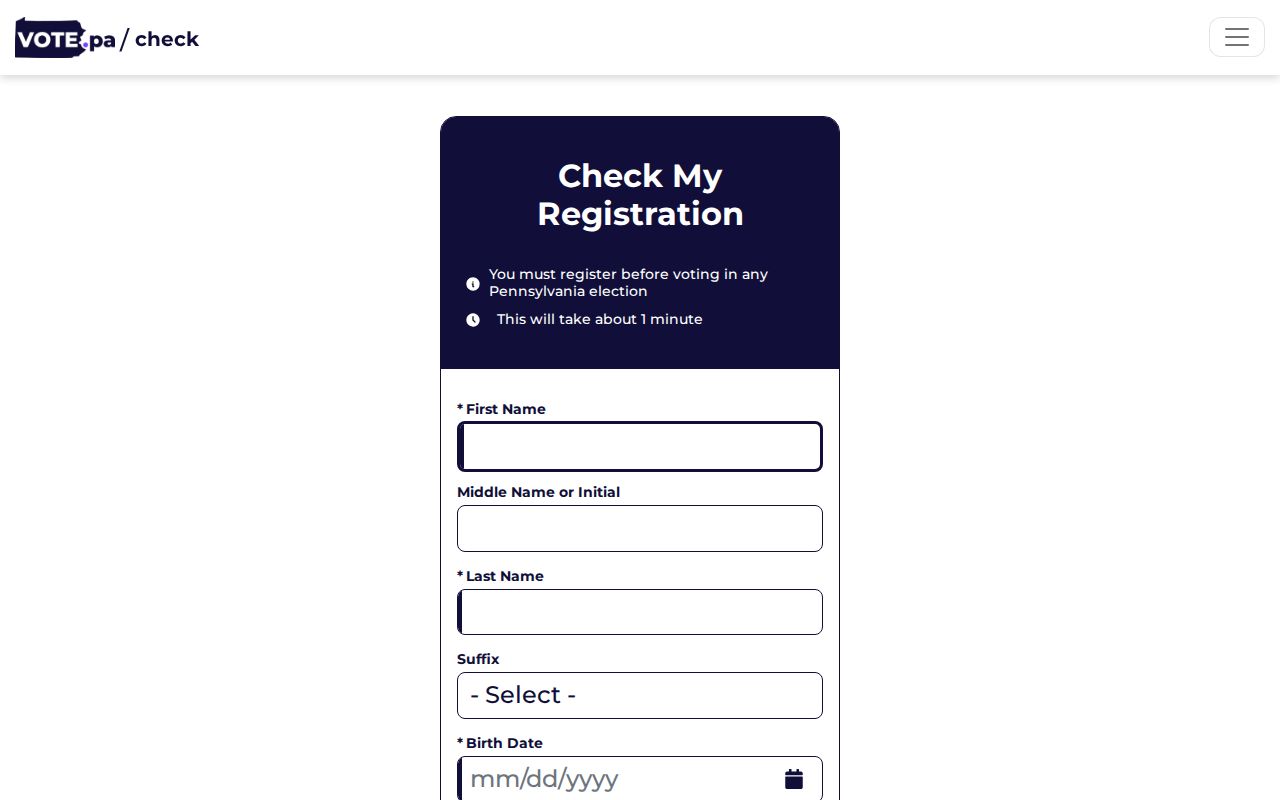 Its individual form layout reflects the difference between confirming a registration and publishing a broad resident list.
Note: The County Voter Registration Office can explain its current forms, deadlines, and lawful list-request procedure.
Erie County Court Docket Searches
For a known public court matter, the statewide UJS Case Search is a free docket-sheet service. Its searchable paths include case number, participant name, organization name, offense tracking number, police incident or complaint number, and State ID number. The Scheduled Events Only control is for future hearings and does not apply to appellate cases. A docket summarizes case actions and status. It is not identity certification or a complete collection of filed documents.
UJS warns that juvenile, expunged, limited-access, and other restricted material may not appear. Some Common Pleas civil information and destroyed Magisterial District Judge records are also unavailable through the public web docket. For an official file or certified copy, identify the case first and contact the relevant Erie filing division. Judicial requests follow Pa.R.J.A. 509 rather than an ordinary county records request.
The UJS Case Search screen displays the Search By and Scheduled Events controls. 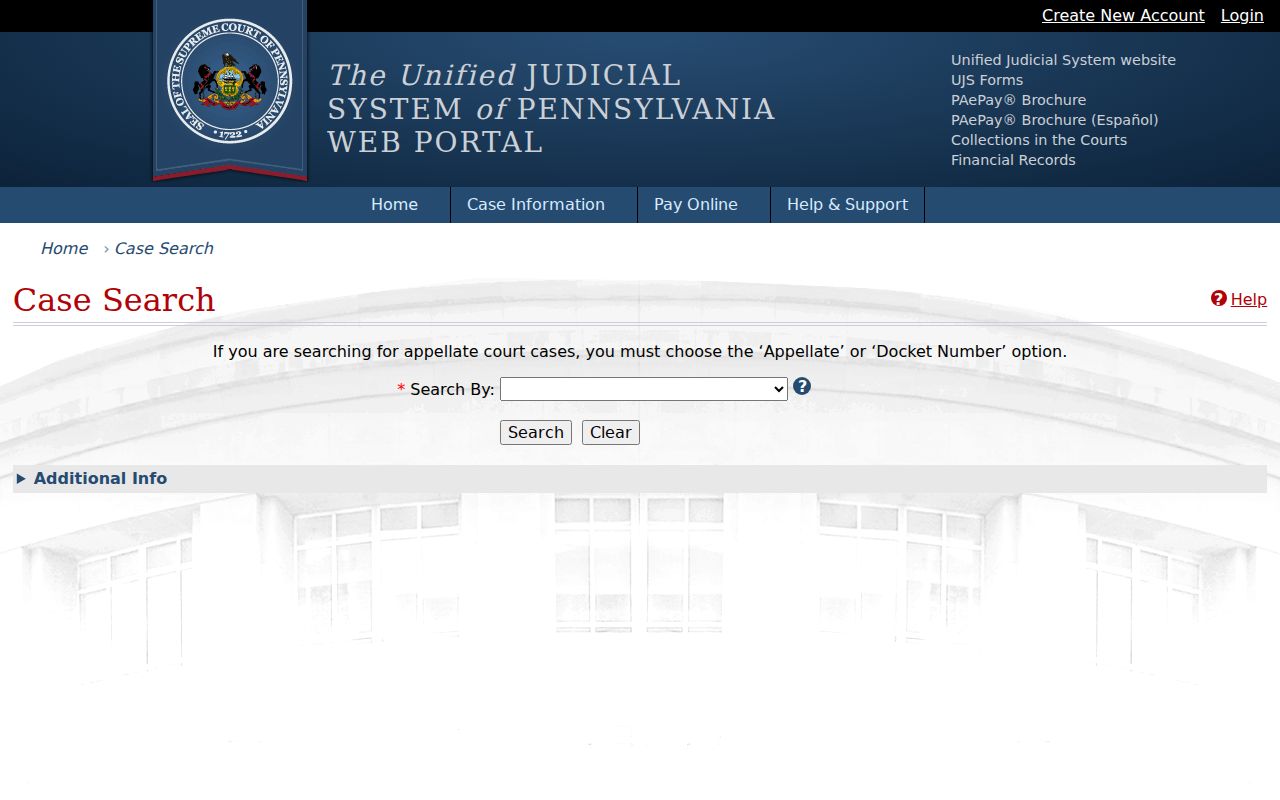 It is best used with a specific public case question and a careful reading of the portal access notices.
Current Erie County Resident Sources
Current records answer narrow questions. The property portal locates land and parcel information. Transfers identify parties to a documented event. Court dockets describe public cases. Voter status confirms one voter registration through a controlled form. None is a complete list of everyone who lives in Erie County, and each has its own access boundary.
| Erie County source | What it can establish | Custodian | Access boundary |
|---|---|---|---|
| Property and Tax Search | Address and parcel route | Assessment | Owner tab is paid and account-gated. |
| Recent Property Transfers | Property event parties, date, and instrument label | Assessment | Event evidence, not a household list. |
| UJS Case Search | Public docket activity and case identifiers | Pennsylvania Judiciary | Restricted records and images may be absent. |
| Registration status | Individual voter confirmation | State and County elections offices | Not a public address browser. |
| Recorder index | Recorded property party roles | Recorder of Deeds | Counter and subscriber access vary by series. |
Official records are more useful than commercial people-finder categories because they identify the custodian, the purpose of the record, and its limitations. Compiled results can be stale, conflated, or incomplete. A custodian correction process controls a government record.
Erie County Vital Record Years
Vital research depends first on the event year. County historical routes include City of Erie births from 1888 through 1905 and deaths from 1894 through 1905 at the Hagen History Center. County birth and death records from 1893 through 1905 are handled through the Clerk of Records historical-information route. Erie County marriage records begin in 1885 through the Clerk of Records. Pennsylvania’s regular statewide vital program begins in 1906.
Modern certificates are not a general public name index. The Pennsylvania Department of Health controls eligibility and identification for certified copies. State Archives access differs again: birth records transfer after 105 years and death records after 50 years. Match the event year to the custodian before requesting a copy, and use the official live form for current eligibility details.
The Department of Health birth-certificate page shows the official request route and fee information. 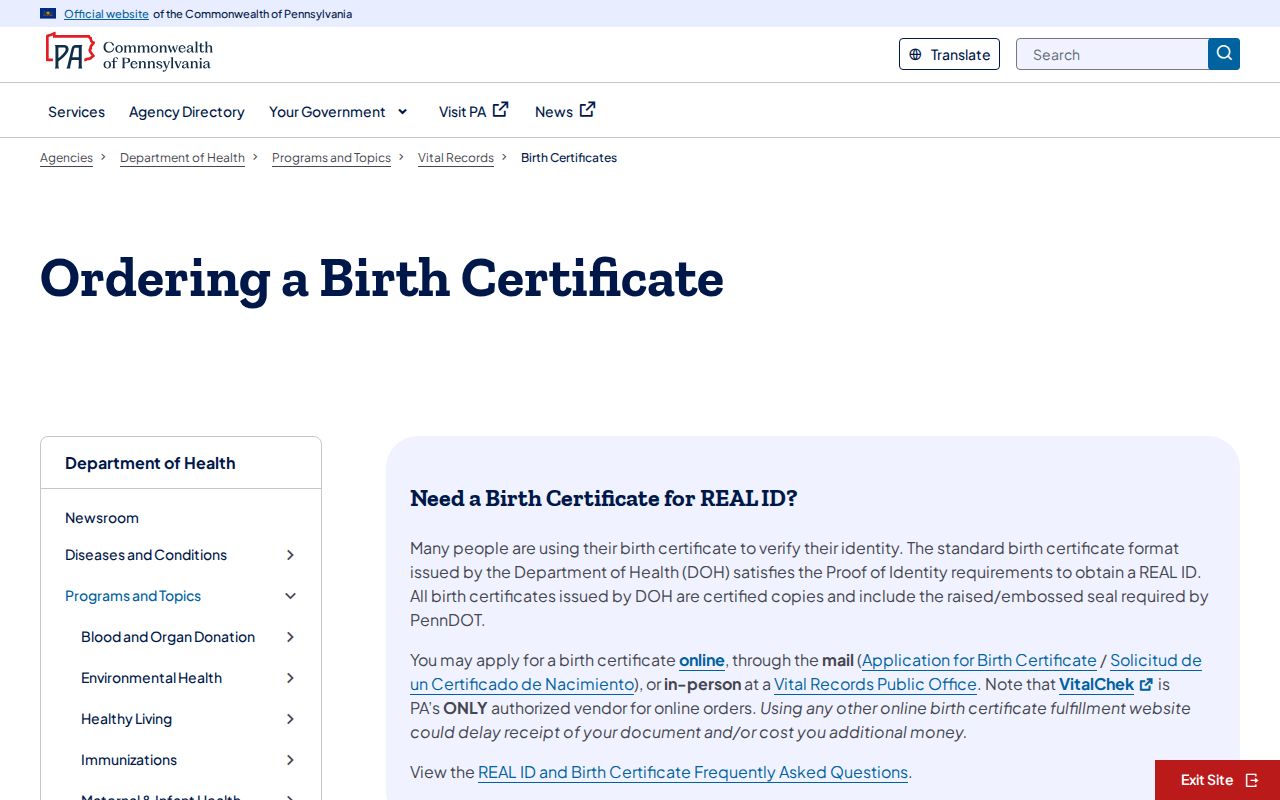 That process is for eligible certificate requests, not browsing a current resident roster.
Note: A historical index or repository reference does not create eligibility for a modern certified certificate.
Erie County Right-to-Know Requests
When a County agency record is not online, Pennsylvania’s Right-to-Know Law offers a written request path. Erie County asks for a requester name and contact information and accepts its formal route as well as in-person, mail, email, or fax submission. The law’s ordinary starting response period is five business days, subject to a timely extension process. Requests should identify the exact record, date span, and desired inspection or copy format.
RTKL is not a universal answer. Court records use the judiciary route, and municipal records such as City of Erie code or permit material belong with the municipal custodian. Vital, election, confidential-address, sealed, and motor-vehicle information can remain protected under other laws. The Office of Open Records publishes the statewide form and fee schedule, while the County identifies its own officers and routing guidance.
Erie County’s Right-to-Know request page identifies the County submission path. 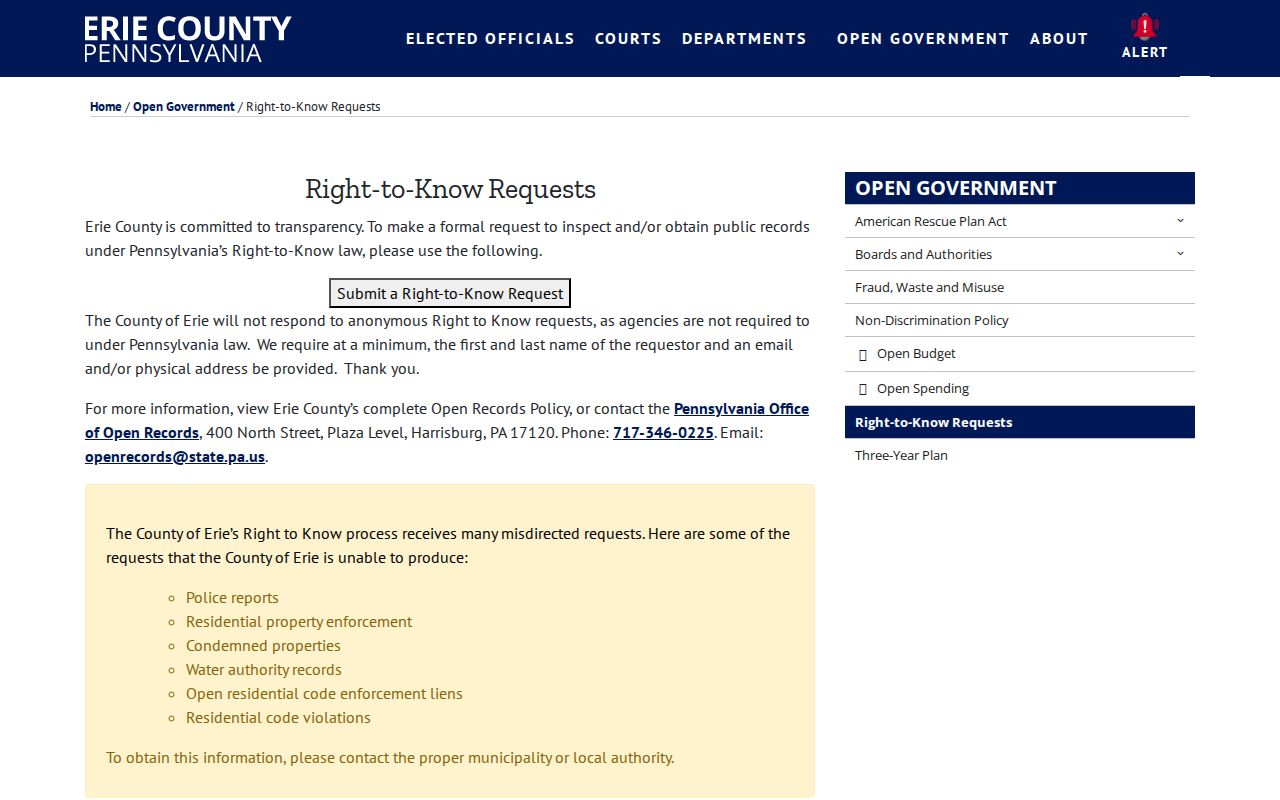 It is a fallback for a defined agency record, not a substitute for the office or portal that already holds the material.
Erie County Historical Household Evidence
The Heritage Room at Blasco Memorial Library gives Erie County family-history work a deep local shelf. Erie city directories begin in 1853, and Millcreek and suburban directories begin with the 1957 edition. The room also provides Erie newspapers on microfilm from 1820 through 2018, Erie County census microfilm from 1800 through 1930, yearbooks, maps, atlases, cemetery sources, and family histories. The collection is on site and noncirculating, with reader-printers, free scan-to-USB or email output, and 10-cent photocopies.
Use a directory year as dated evidence, not as a present-day claim. Record the volume title, year, page, and any abbreviation key that supports an interpretation. Compare adjacent years and then pair the address with a census release, newspaper item, obituary, or deed. The detailed collection and entry-reading method appears on the Erie County city directory page.
Erie County Records Before 1823
Erie County’s first brick courthouse burned in 1823, and historical accounts report that its books, papers, and records were destroyed. That loss is an important local break in the public record trail. It does not mean earlier lives are unknowable. It does mean that a direct courthouse-index promise for the earliest period is not supportable.
Use substitute paths for an early Erie County question: state land material, churches, newspapers, military records, family papers, maps, and re-recorded deeds. The Pennsylvania State Archives finding aid identifies Quarter Sessions dockets from 1823 through 1991, which makes the post-fire route more concrete. The 1851 Bevan map is another local bridge because it depicts dwellings, streets, and a business directory before the 1853 directory shelf begins.
Erie County Resident Privacy Boundaries
Public access has limits. Pennsylvania’s Right-to-Know Law exempts categories such as Social Security numbers, driver-license numbers, personal financial information, personal phone numbers, personal email, and confidential identification numbers. Agencies redact separable protected information. The Address Confidentiality Program can place a substitute address in public records for eligible survivors, and that substitute address is a boundary to respect, not a trail to reverse.
Lawful personal use. Erie County resident records may support family history, estate research, civic questions, and personal record verification. Do not use them to stalk, harass, threaten, or harm anyone. Pennsylvania harassment and stalking laws remain in force.
For an error, contact the record holder with the parcel, case, certificate, or registration reference and supporting documentation. Assessment handles assessment issues, Voter Registration handles voter records, the Department of Health handles vital amendments, and the filing office handles court records. A broad removal demand cannot rewrite an official record.
Historical Erie County Resident Directories
City directories are the historical side of the Erie County residents directory. They can place a named household at a printed address and may also show an occupation, employer, spouse notation, or business listing, depending on the edition. Erie’s local run begins in 1853, while Millcreek and suburban volumes begin with the 1957 edition. The public library does not publish a complete online year-by-year inventory, so a specific catalog record and title page should control any claim about a volume publisher, coverage, or street section.
Hagen History Center is the archival alternative when a question moves beyond the directory shelf. Its King-Mertens Archive Building reports more than 800 collections and 8,200 linear feet of archival material focused on Erie County and the Great Lakes. Appointments and collection-level research help connect a directory household to older papers, photographs, local vital records, or place history without turning historical evidence into a claim about a living person.