
Erie County Previous Residents Sources
Former households at one Erie County address leave different kinds of evidence in different eras. The parcel and transfer routes establish a place and an event. Recorder material establishes a recorded title chain. Directories, census microfilm, newspapers, and obituaries can add the people connected to a dated address. None of those sources is a complete resident list. Use the source that fits the period, then compare the name, address form, municipality, and date before joining the results.
| Source | Years It Covers | Where Held | What It Shows |
|---|---|---|---|
| Address and parcel search | Current site; cutoff not stated | Erie County Assessment | Situs-address route and 14-digit parcel number; owner detail has a paid gate. |
| Recent property transfers | Current rolling display; start not stated | Erie County Assessment | Municipality, address, seller, buyer, instrument, price when reported, and date. |
| Recorder history | 1976-1995 | INFOCON and Recorder | Grantor and grantee history, with images stated for that group. |
| Recorder deed books | Prior to 1976, books 1-1191 | INFOCON and Recorder | Scanned historic deed-book route. |
| City directories and census microfilm | Directories begin 1853; census 1800-1930 | ECPL Heritage Room | Dated address and household leads, subject to each volume's coverage. |
| Sanborn maps | 1888, 1900, 1921, and 1950 | Library of Congress | Building and street configuration, not a person list. |
For a recent question, start with the parcel and transfer record. For an earlier Erie or Millcreek question, add the appropriate directory volume before assuming a name is missing. Note: Preserve the exact source date because a recorded transfer and a move may not occur at the same time.
Erie County Address Records Start
Use the address as a way into the parcel, not as the legal identity of the property. The County's Property and Tax Search accepts house number, street direction, and street name. For the street-name field, enter the name without a suffix such as Street or Road. If the normal address route does not find the place, use the separate parcel route with all 14 digits and no spaces, or check the map route. Record the municipality and the current situs form before searching deeds.
| House Number | Optional address component for the County search. |
|---|---|
| Street Direction | Optional direction selector used with the street name. |
| Street Name | Enter the name only, without a street-type suffix. |
| Parcel Number | The separate route requires exactly 14 numeric characters with no spaces. |
| Transfer filters | Oldest Date and Newest Date use mm/dd/yyyy; Municipality narrows the public list. |
Erie County Property and Tax Search links the address, parcel-number, transfer, and map modes. Its Owner tab is not a free result field: registration, login, and a $100 unlock payment are required. A situs address locates the parcel; it does not establish an owner mailing address or prove who lived there.
Erie County Deed Record Chain
A deed chain is the title trail behind a parcel, not a list of every past household. Start from the parcel's legal description and a recent transaction lead, then obtain the recorded deed. The buyer on a deed is the grantee and the seller is the grantor. To move backward, find the known owner's acquisition as grantee, identify the grantor on that deed, and then seek the earlier deed in which that grantor acquired the property. The legal description helps when an older instrument has no modern street number.
- Find the current situs address, municipality, parcel number, and available transfer result through Assessment.
- Use the seller, buyer, instrument, date, and parcel legal description as leads, then locate the recorded deed.
- Read the deed for the grantor, grantee, recording date, book or document reference, and legal description.
- Search that prior grantor as a grantee in an earlier conveyance, while checking that the legal description still matches.
- Repeat the chain through the Recorder counter or the relevant legacy group when the remote path does not supply the book.
- Grantor
- The party conveying an interest in a recorded instrument.
- Grantee
- The party receiving the interest in that recorded instrument.
- Chain of title
- The sequence of conveyances used to follow a property interest backward through records.
- Legal description
- The lot, block, subdivision, metes-and-bounds, or comparable land description that connects old deeds to a parcel more reliably than a street address.
The Erie County Recorder of Deeds records and indexes deeds, mortgages, satisfactions, powers of attorney, leases, UCC filings, and other instruments. It cannot give legal advice. At the courthouse, the Recorder is in Room 121 at 140 W. Sixth Street, and the published phone number is 814-451-6246.
Erie County INFOCON Legacy Records
INFOCON's Erie availability labels divide the historic remote path into useful time bands. The service identifies scanned Recorder deed books 1 through 1191 as prior to 1976. It separately labels Recorder of Deeds grantor and grantee history and maps for 1976 through 1995. Those labels help choose a route, but they do not establish that every instrument, image, or current cutoff is available remotely. Call or visit the Recorder when a needed book or document class is not found.
INFOCON County Access is the county-linked subscriber route for the legacy groups.
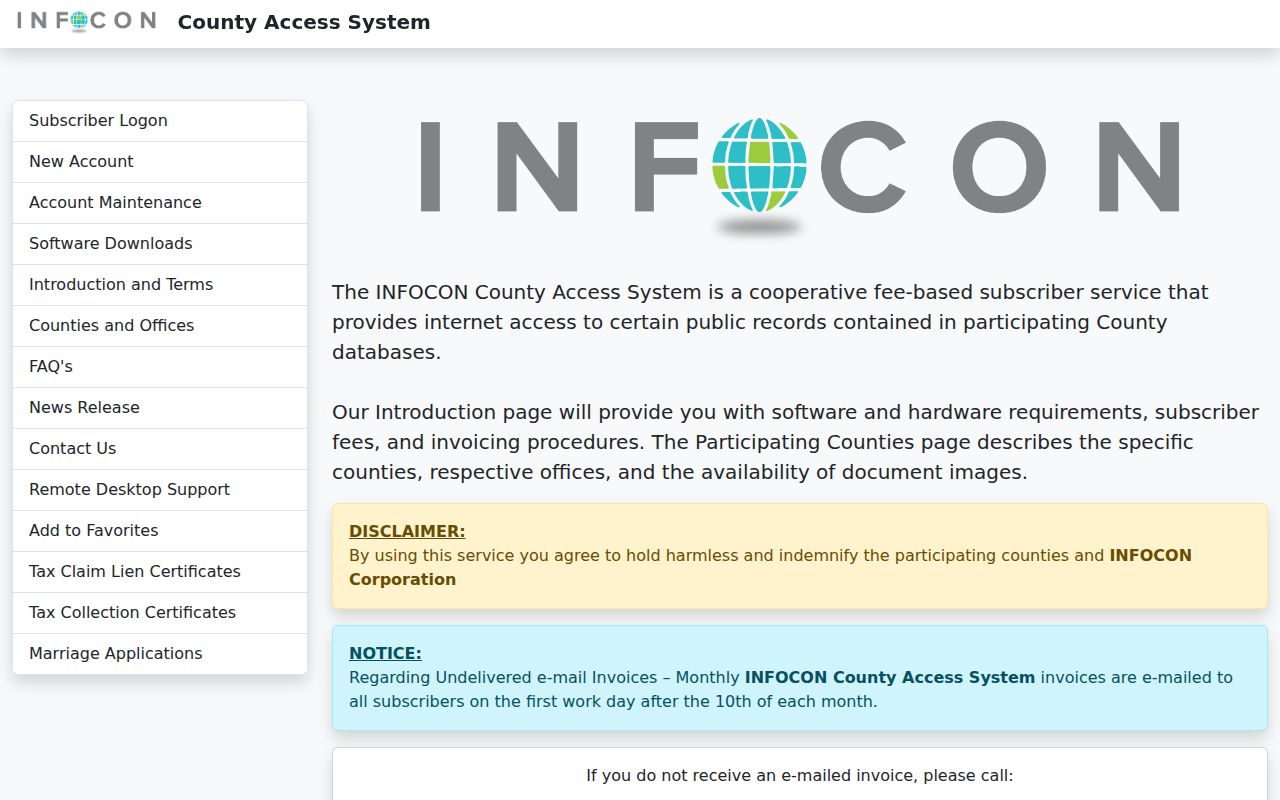
The subscriber landing screen does not replace the Recorder counter. An independent office search remains available, and the Clerk's Record Information page says a staff-performed search costs $20. Note: Ask the custodian about the current end date and image availability for the particular book or instrument.
Erie County Household Records Trail
Property ownership and occupancy are different questions. To investigate who lived here before, pair the deed sequence with dated directory and census evidence. ECPL's Erie city-directory run begins in 1853, while the Millcreek and suburban run begins with the 1957 edition. The library does not publish an exhaustive list of annual gaps or all reverse sections, so inspect the selected volume's title, contents, and abbreviation key. The historical collections themselves are described on the Erie County city directory page.
- Choose the directory volume nearest the deed or transfer date and transcribe the address exactly as printed.
- Check earlier and later available volumes for a move, spelling variant, or changed family notation.
- Use an address, reverse, or criss-cross section only if that specific volume contains one.
- Pair the directory date with the nearest released federal census and ECPL's Erie County census microfilm.
- Use a newspaper or obituary to test a departure, death, or kin connection without assuming a single cause.
ECPL holds Erie newspapers on microfilm from 1820 through 2018 and keeps a printed obituary index for 1822 through 2017. Its online obituary-service pages describe different coverage end points, so retain the date statement attached to the result. A directory entry or census row is evidence for that record's date, not a claim about a present household.
Erie County Sanborn Records Check
Sanborn maps help answer a building question, not a person question. The Library of Congress has digitized Erie map material for 1888, 1900, 1921, and a 1950 edition. The 1950 volume is described as having 105 sheets with revisions through October 1950. Compare the map's street pattern, footprint, and use with the address wording found in a deed or directory. That comparison can show whether a structure existed or whether a lot changed, but it cannot identify an occupant.
The Library of Congress Erie Sanborn volume links the 1950 map with the earlier Erie editions.
Hagen History Center's research collections provide an appointment-based archival route for place history beyond the map sheets.

Hagen reports more than 800 collections and 8,200 linear feet of material that can add neighborhood, family, or building context.
Erie County Estate Record Endpoints
Obituaries, cemetery indexes, and probate files can help explain why a name stops appearing near an address. They are endpoints and context sources, not substitutes for a deed or an address record. An obituary may identify relatives or a date. A probate file can provide an estate reference. Neither should be used to expose the private contact details of a living person. The Register of Wills reports probate coverage from 1823 to the present, and its office can explain file or copy procedure.
ECPL's obituary service supports surname, given-name, middle-name, and obituary-date searching. The service advises using up to two terms and no punctuation; the returned date is the newspaper publication date. For an estate or historical vital question, the Clerk of Records has separate custodians and search channels, so use the office that holds the record rather than treating an index as the final document.
Erie County Before 1823
Early Erie County research has a documented break. The first brick courthouse burned in 1823, and contemporary county history says the fire destroyed books, papers, and records. A missing pre-1823 county entry is therefore not a reliable negative result. Look instead for re-recorded deeds, state land records, churches, newspapers, military records, maps, and family papers. The Pennsylvania State Archives finding aid lists Erie County Quarter Sessions Dockets from 1823 through 1991, which is one post-fire research route where that record type fits the question.
The 1851 Bevan map and the 1853 Erie directory offer later place evidence, but neither repairs the courthouse loss. Treat the transition as a source boundary and cite every substitute record on its own terms.
Erie County Previous Residents Limits
An address trail can show a parcel, a transaction, or a dated printed listing. It cannot reliably identify every person who lived at an address, establish a current location, or reveal protected records. The County's paid Owner tab, controlled voter-list rules, and the limits on utility, motor-vehicle, and confidential-address information are boundaries to respect, not workarounds to defeat. A research result should stay tied to the source, its date, and its stated access conditions.
When a record is missing or restricted, contact the appropriate custodian and ask about its public access route. Keep a chronological log of parcel numbers, legal descriptions, directory citations, and conflicting evidence so the trail remains reviewable.