
Erie County Directory Collections
The Erie County Public Library Heritage Room at Blasco Memorial Library is the practical starting point for historical directories. Its public collection statement confirms Erie city directories beginning in 1853 and a separate Millcreek and suburban run beginning with the 1957 edition. Those are starting points, not a promise that every intervening year or publisher survives. Check the catalog record and the chosen volume's title page before recording a title, publisher, or gap. The shelf is on site and noncirculating, which makes a visit necessary for much of the evidence. The catalog can establish that a title exists locally, while the volume itself establishes what that edition prints. That distinction helps when a catalog result is brief or an adjacent directory year is unavailable.
| Collection | Years | Where Held | Access |
|---|---|---|---|
| Erie city volumes | Beginning 1853 | ECPL Heritage Room at Blasco | On site and noncirculating; verify each year in the catalog. |
| Millcreek and suburban directories | Beginning with 1957 edition | ECPL Heritage Room at Blasco | Use the individual volume for its coverage and format. |
| Digitized 1853 Erie directory | 1853 | FamilySearch collection | Digitized 39-page volume; access and image rights can vary. |
| Erie newspapers and census microfilm | Newspapers 1820-2018; census 1800-1930 | ECPL Heritage Room at Blasco | Use as dated household and context evidence alongside a directory. |
A catalog search may identify a title such as Directory of Erie City and County, Pa. for 1870-71, but the catalog and title page remain the safer source for the edition's exact form. The library does not publish a complete annual checklist online. Note: Record the directory title, date, page, and any abbreviation-key page before leaving the collection.
Erie County Heritage Directory Shelf
The Heritage Room is more than a directory shelf. Its historical maps and atlases, local files, cemetery records, family histories, yearbooks, and county histories can test what a printed listing suggests. Five reader-printers handle the newspaper and other microfilm. Staff provides free scans to a USB drive or email, while photocopies cost 10 cents. The room's printed obituary index covers Erie newspapers from 1822 through 2017; the library describes its online service with differing end-date language on separate pages, so preserve the coverage label shown with the result.
The Erie County Public Library catalog is the right first stop for checking whether a chosen directory title or date is represented locally.
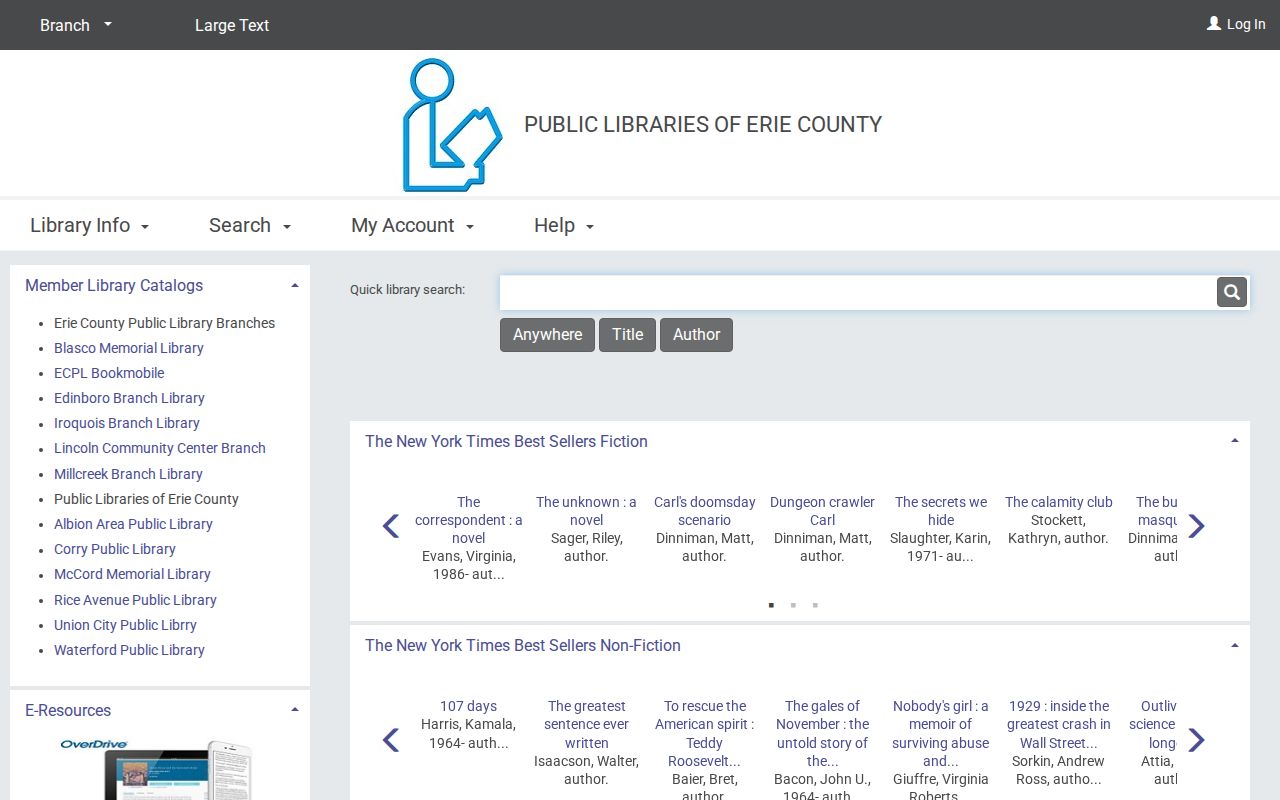
The catalog image is a reminder to confirm an actual edition before relying on a directory citation. For in-person preparation, the library's Heritage Room genealogy information identifies the local-history holdings and access limits.
Erie County Directory Access Paths
Several useful research paths are available only from the Heritage Room or under the terms of the provider. The library lists Ancestry Library Edition and American Ancestors for in-library computers. It is also a FamilySearch Affiliate Library, which can make some limited-access images available at the library even when they are not available from home. Image rights still vary, so a result screen or catalog listing is not a blanket promise of access.
HeritageQuest and Fold3 are described by the library as available in the library and remotely for eligible users. Yearbooks from many Erie City and County schools, some dating to the early 1900s, add another dated identity clue. Use those materials to corroborate a name, school, place, or time period. They do not replace the directory volume, and they should be cited separately from it. A library database hit, a microfilm item, and a printed volume may each have different access rules, page citations, and image limits. Keep the medium in the citation as well as the date.
Reading Erie County Directory Entries
Read an Erie County directory entry as a printed snapshot, not as a modern profile. No local entry page or abbreviation key was captured during the research, so it would be unsafe to assign a meaning to a particular mark. Instead, transcribe every element exactly as printed and photograph or copy the key from that same volume. Initials, spelling variants, a spouse or widow notation, and an address may all help distinguish two people with the same surname.
| Name | Surname, forename, initials, and the spelling or sort order used by that edition. |
|---|---|
| Family notation | Any spouse, widow, widower, or gendered-name notation exactly as the volume prints it. |
| Occupation or business | An occupation, employer, place of business, or business address only when it appears in the entry. |
| Residence line | House number, street form, and any ward or area wording printed in the listing. |
| Edition evidence | Title, publication year, imprint, page, listing type, and the location of the abbreviation key. |
- Criss-cross directory
- A directory section arranged by address or street rather than alphabetically by surname, if that volume includes one.
- Householder index
- An index that identifies the named household contact for an address in the way a particular publication defines it.
- Abbreviation key
- The page in a volume that explains its own shortened terms and symbols. Copy it before interpreting an entry.
Erie County Household Directory Trail
A household trace gains strength by moving through available Erie County directory volumes one at a time, rather than jumping between decades. Begin in the alphabetical part when a surname is known. Then compare the precise address and wording in adjacent available volumes. A move, a changed employer, a new spouse notation, or a disappearance is a lead for another record, not a conclusion by itself. The next source should fit the question and the date.
- Find the surname in a dated directory and copy the entry, title, page, and edition details exactly.
- Check available earlier and later volumes for the same spelling, variants, address, and printed family notation.
- Use a street or reverse section only after confirming that the selected volume actually contains one.
- Pair the dated address with the nearest released federal census and ECPL's county census microfilm.
- Use a newspaper, obituary, cemetery, deed, or assessment record to test a move, death, or property connection.
A person who vanishes from a listing may have moved, died, appeared under a variant, been omitted, or encountered an address change. Erie County census microfilm covers 1800 through 1930 at the Heritage Room, while released federal census material has its own access timing. The evidence should remain separate until the names, date, address, and surrounding facts agree.
Erie County Directory Boundaries
Erie and Millcreek do not begin on the same documented directory timetable. The Erie run begins in 1853, while the Heritage Room says its Millcreek and suburban directories begin with the 1957 edition. That difference matters when a family lived outside the City of Erie or moved across a municipal line. A missing name in an Erie volume does not establish that the person was absent from the county.
Mercyhurst's catalog description of an R. L. Polk Erie Pennsylvania City Directory mentions an alphabetical directory, a street directory of householders and businesses, a classified or buyer guide, and a numerical telephone directory. It describes that work, not every local volume. Check the title page and contents of the specific edition before expecting any one of those sections. Note: A dated address and the exact municipality are more useful than an assumed countywide directory boundary.
Erie County Directory Archives
When the directory entry raises a question that the library shelf cannot settle, the Hagen History Center provides an archival route. Its King-Mertens Archive Building holds diaries, correspondence, books, typescripts, reports, photographs, and other Erie County material. Hagen reports more than 800 collections and 8,200 linear feet of archives, plus a reading room with more than 5,800 books. That scale makes its catalog useful before an appointment, especially for a family, neighborhood, or property name that appears in a directory.
Hagen History Center's research page gives the Library & Archives appointment route and schedule.

The archive is also the County-specified research source for City of Erie births from 1888 through 1905 and deaths from 1894 through 1905. Search the Hagen catalog before scheduling, then ask the archives staff which collection or access condition applies.
Erie County Before Directories
The first documented Erie directory landmark follows an earlier mapping landmark. The Pennsylvania Historical and Museum Commission catalogs John Bevan's 1851 Erie map as showing dwellings, streets, and a business directory. It can bridge a place question just before the 1853 directory start. The map identifies a physical setting and a contemporary business context, but it is not proof that every person associated with a street lived there.
The earliest courthouse record trail has a hard local limit. The first brick courthouse burned in 1823, and the county history says its books, papers, and records were destroyed. Earlier research may need state land sources, re-recorded deeds, churches, newspapers, military material, maps, or family papers instead of an assumed county index. The PHMC map listing is the starting citation for the Bevan map.
Erie County Directory Limits
Printed directories are historical publications with editorial choices, date lags, and uneven coverage. They can supply a strong name, address, and time lead, yet they do not independently prove a whole household, a legal relationship, or a current location. A printed residence line should not be converted into a claim about a living person. When the need shifts to a dated address chain, official parcel and recorded-document sources provide a different kind of evidence.
Keep an evidence log with the volume date, page, transcription, and the source used to confirm it. That practice makes a city-directory discovery useful without stretching it beyond what the printed entry supports.